K.
V. Switzer, #261
“I
wasn’t running Boston to prove anything; I was just a kid who wanted to run her
first marathon.” –Kathrine Switzer
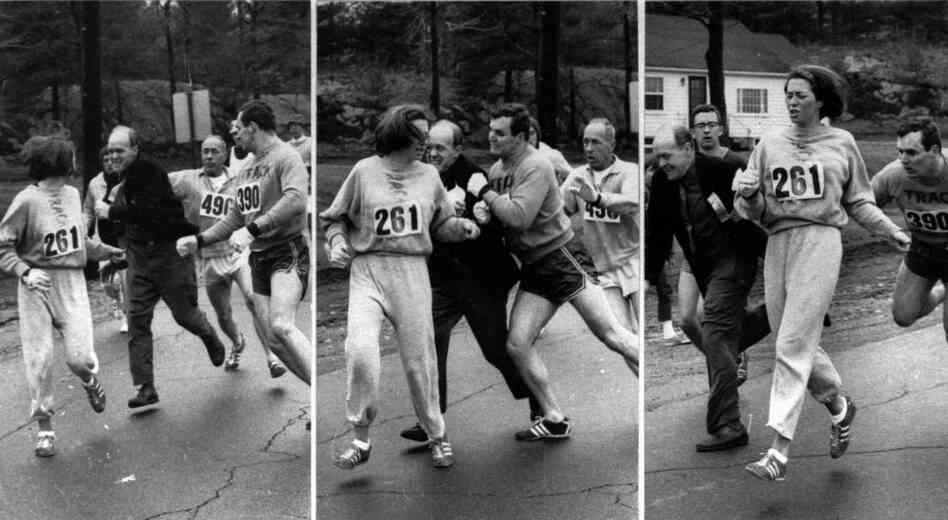
1967 was a dynamic year for
progress and social change. 1967 saw the appointment of the first Black Supreme
Court Justice, the honorable Thurgood Marshall. The Supreme Court ended laws
banning interracial marriage. It was the year Aretha Franklin released R.E.S.P.E.C.T.,
which is fitting in light of what I have learned about Kathrine Switzer. On
Patriot’s Day of that year, as is true every year since 1897, the 71st
Boston Marathon was run in Boston, Massachusetts. A man by the name of Dave
McKenzie won that year with an impressive time of 2 hours and 15 minutes. A
lesser known and quieter victory is that of K. V. Switzer, who was the first
registered woman to run the Boston Marathon.
Switzer
did not technically break any rules by entering the race. There were not any
official regulations against it; however, there were many beliefs that a woman should not participate in long distance runs because it would hurt her
reproductive system. There is zero empirical information to support this claim,
but it was the belief of the time. Kathrine trained hard, even out running her
trainer during her distance trial, 3 weeks before the race, by running an extra
5 miles, 31 miles total. Her trainer, Arnie, a seasoned marathoner, passed out
from the massive effort of running the distance with her.
When
race day finally arrived, Kathrine was ready and confident, albeit, humbled by
the gifted athletes she was running alongside. She received overwhelming
support and encouragement from her male peers, one of who stated, “It is great
to have a girl out here. I wish I could convince my wife to run.” A few miles
into the race, her group was approached by the flatbed press truck. The
reporters soon realized there was a woman in their midst and began rapidly
asking her questions and taking her picture. She waved gregariously, happy to
be part of such a prestigious race. The Marathon Director, Jock Semple, was
aboard this truck. When he realized a female had entered the race, he jumped
from the truck and ran after Kathrine. He pawed at her and tried to rip off her
numbers, all the while screaming, “Get the hell out of my race and give me those
numbers!” Kathrine kept running. Her companions and fellow racers came to her defense.
She kept running. The press tuck caught up to her again, but this time the
questions asked were far less positive……”So, when are you going to quit?” and
“What are you trying to prove?”
Kathrine
had not started the race trying to prove anything. She was simply a runner who
wanted the opportunity to run a marathon, which is a big deal among runners. She
did finish the race that day. In 1972, women were officially allowed to enter
and race the Boston Marathon. Kathrine’s determination that day was instrumental
in this rule change. Kathrine Switzer says it best when she describes what she
was thinking during the race:
“The distance,
as it always does, gave me time to think and dissipated my anger. Jock Semple didn't take me seriously, and
that's why he attacked me. I wondered why other women didn't run, thinking that they just didn't get it.
Wait a minute, maybe they believed all
those old myths like running ruins your reproductive organs, and it scared them
away because they didn't know
better and nobody gave them opportunities to disprove this nonsense. My folks and Arnie had
given me this chance, and it dawned on me that I was not special after all; just lucky. My thinking rolled on: The reason
there are no intercollegiate
sports for women at big universities, no scholarships, prize money, or any races longer than 800 meters is because
women don't have the opportunities to prove they want those things. If they could just take part, they'd feel the
power and accomplishment and the
situation would change. After what happened today, I felt responsible to create those opportunities. I felt
elated, like I'd made a great discovery. In fact, I had.”
Kathrine Switzer is absolutely right.
Some women do not know their power. They do not know that they can do it. I hope
Kathrine’s story empowers women and men both the way it has empowered me, and I
certainly hope to make an impact like she did. I am quite enamored of this woman
and her tenacity. Sometimes we don't know the difference we are making until we
are right in the middle of the fray. Sometimes we just want to run the race too
and end up kicking a hornets' nest.
References:
Switzer, K. “The Girl Who Started It
All”. Runner’s World. March 26, 2007.
PBS. “MAKERS: WOMEN WHO MAKE AMERICA”. Aired on: 2/26/13.
